
Eddielogic

– Thoughts on Strategy and Management

December 7, 2009
by Oliver
Comments Off on Consumer trends for 2010

Consumer trends for 2010

trendwatching.com, a leading trend firm, has just released its ’10 Consumer Trends for 2010′. According to this trend report next year will bring a bonanza of opportunities, as even cautious consumers crave pragmatic or exciting innovations.Its argues that we will see a scene from ‘urban pride’ to ‘forced sustainability’.

The summary:

  1. BUSINESS AS UNUSUAL | Forget the recession: the societal changes that will dominate 2010 were set in motion long before we temporarily stared into the abyss. And even when the downturn ends, there won’t be a return to ‘business as usual’.
  2. URBANY | Extreme urbanization will lead to more sophisticated and demanding consumers around the world. Urban culture is THE culture.
  3. REAL-TIME REVIEWS | Whatever new product or service gets launched in 2010, it will be reviewed in real time. Transparency tyranny (or triumph) is upon us.
  4. (F)LUXURY | With status symbols becoming more fragmented, luxury is whatever consumers want it to be in 2010.
  5. MASS MINGLING | Online lifestyles are actually fueling real world meet-ups, shattering all predictions about a virtual and socially isolated future.
  6. ECO-EASY | In 2010, corporations and governments will force consumers to be more green by restricting the alternatives. Say goodbye to consumer choice.
  7. TRACKING & ALERTING | Tracking and alerting are the new search. Next year, consumers will further expand their sphere of control.
  8. EMBEDDED GENEROSITY | Generosity as a trend will further adapt to the zeitgeist, leading to more pragmatic and collaborative charity.
  9. PROFILE MYNING | With hundreds of millions of people now nurturing their online profiles, 2010 will be about consumers making money from these profiles, from intention-based
  10. MATURIALISM | 2010 will be even more opinionated, outspoken and raw than 2009; thank the anything-goes online world for that. Which brands will be equally daring?

The full, free briefing of consumer trends 2010 can be found on this site (pdf-file).
November 1, 2009
by Dagmar
Comments Off on Babies and Strategy

Babies and Strategy

As you might remember, our team was completed by our baby last year. Our little daughter is now 14 months old and makes us very happy. Looking back at the time with her, I see some parallels between living with a baby and strategic management:

Let’s start with the time before the baby arrives. The expecting parents are more or less in-formed about their future challenges. By this time, most parents have a general idea of how they want to live with the baby, how they want to bring the baby up and what kind of person it should (hopefully) become. Most parents wish their baby to become a strong, self-confident and happy person. Hopefully it will be very intelligent and will outsmart its little friends in the toddler group. Nevertheless, many issues still are very vague to them and they need to figure out many details. But not all of these details need to be decided right now. Many issues can wait until these particular situations arise. It will be easier and wiser to solve these questions with the detailed knowledge of the real-life situation.

You can compare this stage with the pre-startup phase of a new business. In this stage, the expectant entrepreneur has a general idea of what kind of business he is going to start and what he wants to achieve with it; i.e. he has developed an overall vision of his business. However, many details of his business plan still need to be worked out. Continue Reading →

October 18, 2009
by Oliver
Comments Off on Tuck professors named to top 50 management thinkers list

Tuck professors named to top 50 management thinkers list

Tuck professors Vijay Govindarajan and Richard D’Aveni have once again been named to the Thinkers 50, the 4th biennial ranking of the world’s most influential living management thinkers. Tuck professor Sydney Finkelstein is also named as a management thinker to watch.

Created and compiled by Stuart Crainer and Des Dearlove of CrainerDearlove*, Thinkers 50 has established itself as the definitive biennial guide of both thinkers and ideas which have shaped strategic management thinking today. Among this year’s top thinkers are Indian-born management expert CK Prahalad (1), Malcolm Gladwell (2), and Paul Krugman (3). The entire top 50 lists for all awards since 2001 are available on the results page of th eThinkers50 website. Continue Reading →

September 17, 2009
by Oliver
1 Comment

Essential small open source tools for managers

Keeping track of all tasks and projects can be difficult sometimes. However, this is an essential part of manager’s roles. That led us to the question, whether there are any small pieces of software which might help managers to keep track of all their duties. Well, in most cases you might use MS Outlook (or other types of groupware) but that is not the best solution for all situations. Of course you can spend extra money to buy several types of add-ins, but sometimes I don’t want to spend extra money to solve a specific problem.

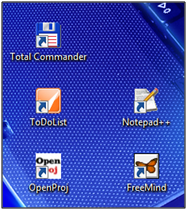
So let’s have a look on my laptop screen which tools I use.

I have installed 5 small pieces of software which I found most helpful. Furthermore they are all free software. To be more specific, 4 are true open source programs and 1 is shareware but it works fine without registrations (there are no limitations within the unregistered version of the software). Let’s us start on the top of the left side.

Total Commander is an excellent file manager that has additional features like file compressing, ftp-server access and comparing folders. Some of you may remember the Norton Commander – and that is what “Total Commander” actually wants to be. Hence the second part of the name is commander. That piece of software is easy to use and helps you to organize all your files. The two window screen is most helpful. You can download the software on this website. TC is shareware and the programmer has been made releases in a constant way.

ToDoList is – as expressed by the name – a program to organize all your “to-do’s”. You can create and organize tasks and their subtasks, set priorities and structure your tasks by categories. There are dozens of flags to organize or to mark your tasks, and of course you can filter and group your tasks by those flags. You can download the software on this website. TDL is open source.

Continue Reading →

September 4, 2009
by Oliver
Comments Off on Heroes of cost cutting

Heroes of cost cutting

A provider of on-demand sales tools and related services has published an interesting paper on cost cutting. Its title is quite promising: “Simple Savvy Savings – 9 ideas to make anyone a Cost-Cutting Hero”. The underlying idea behind this paper is the current financial crisis and the resulting consequences, i.e. in terms of cost cutting: “The economic downturn has IT executives scrambling to defend budgets, avoid cutbacks, and help the business survive”. Taking this aspect into consideration it might be good to identify approaches to achieve “cost cutting quick wins” asap. And that is exactly that what the paper wants to achieve since it presents “….simple savvy savings that prove that you don’t need to look hard to find fast payback projects to deliver significant annual cost savings”. For this purpose the paper outlines 9 easy and quick payback ideas and approaches (IT related) to deliver on these savings.

On this website you have free access to the white paper (pdf format file).

June 23, 2009
by Oliver
1 Comment

Basic rules for e-mail campaigns

A few days ago I did participate in a discussion concerning the transfer of existing print mail campaigns to new e-mail-campaigns. An issue within this discussion was, whether and to what extent content and structure should be changed.

The basic answer can be summarized as follows: E-Mail campaigns are quite different in comparison to print mail campaigns. Different reading habits when reading “online” require different structures and concepts for e-mail campaigns. Due to research results we know the following reading habits:

  • An e-mail text is more browsed than read in detail.
  • The attention to read the entire text needs to be attracted with anchor words or even buzz words.
  • Only the first 10 rows will be absorbed in total.
  • The reading rates online is lower than offline.
  • Customers expect that the sender gets to the point as soon as possible.
  • Customers will not follow all arguments to the bottom line.

Taking these reading and abortion styles into considering the following rules and recommendations can be derived:

  • Write to your readers what is most important right at the beginning.
  • The entire text of your mail should not excess the half of the letters text.
  • The line of arguments should have a maximum of three layers.
  • Your e-mail should be clearly arranged. Hence your mail needs more paragraphs compared to a letter.
  • Each paragraph should contain only one core message.
  • Avoid nested sentences.
  • The salutatory address should include the sir name.

Continue Reading →

May 31, 2009
by Dagmar
Comments Off on 20 years old news

20 years old news

There is a saying that nothing is as old as yesterday’s news.

This week I read a newspaper article about much older news. As it seems, these can be quite interesting again. Most people, including me, did not even notice it: one of Germany’s most popular TV news formats – Tagesschau – has been broadcasting its own issues from exactly twenty years ago since 1993. So today you can see the news from May 31st 1989. These newscasts are exactly as they were broadcasted originally, including slips of the tongue and weather forecast. Unfortunately, the time of the broadcast is 3 a.m. in the morning and thus, not very convenient for me.

What has all this to do with strategy? I think a lot. A 20 years old news format is not only entertaining. It is more than a recall of fashion trends, dreadful haircuts and log forgotten events. At the original broadcasting date, all this was brand new information, often still incomplete. Commentators were speculating about potential future effects of latest events. Nobody knew were all this would end. Nobody knew if a particular event would even have any relevant consequence or not. Continue Reading →

May 26, 2009
by Oliver
1 Comment

Risks of external consultants and interim managers…

…and how to manage them. When company managers discuss their personal experiences in terms of external consultants you can find a broad range of opinions and beliefs. Point of views may vary between very positive experiences when hiring external knowledge and very bad experiences; the later ones are sometimes expressed in jokes about “flippy” PowerPoint presentations or even statements that those experts only summarize knowledge that was available in the organization all the time.

The truth is that most of those experiences can be proofed; furthermore there is a very high probability that you going to meet both types of consultants (the good ones and the bad ones) after several years in business. One typical kind of problem: Presented results look good on PowerPoint, but not in corporate practice. Process time is assumed to short; certain – in most cases hidden processes – have not been considered and hence do not appear in new flow charts. Essential details and former best practice will not be transferred to new solutions. (From my personal point of view in most cases those “details” and hidden processes make or break large projects, e.g. success of acquisitions, outsourcing). Another frequent problem can be observed in terms of knowledge that leaves the organization. Hiring external expertise for a certain period of time may solve your problems today (e.g. to implement a new IT system), but in some cases the organization will end up with a very expensive black box.

Similar problems can be observed when hiring interim managers for small period of time. The reason: Both groups (consultant, interim manager) are paid to deliver certain project results, but not to live the conditions and organizational surroundings they create. Hence the question is whether there is any chance that you can protect your organization and your team from those consulting dilemma (you need the external experience or the external capacities to fix your problems).

Continue Reading →

April 21, 2009
by Dagmar
Comments Off on Porters Generic Strategies During the Current Financial Crisis

Porters Generic Strategies During the Current Financial Crisis

Last week I was asked about my opinion about Porters Generic Strategies during the current financial crisis. My first spontaneous thought was: Why ask that question? Is it less important to have a distinctive strategy during a crisis than it is during a boom? I think the contrary is true.
However, my discussion partner expected a more detailed answer.

As a reminder – Porters model of Generic Strategies basically says that you should follow one of these generic strategies:

  • Price leader / cost leader – Sell your product for the lowest price in the market. Don’t add bells and whistles; your customers are price sensitive. Examples are the cloths you can buy at Wal Mart.
  • Differentiation – Have a unique product and sell it for a premium price. This is often equivalent to quality leadership (but not necessarily so). Examples are Gucci stores.
  • Focus – I prefer the term niche strategy since it is more self-explaining. Have a product with a fair price that fulfils the needs of a customer segment that is not larger than a market niche. Examples are the cloths specially designed for carrying babies in a wrap or a sling, e.g. extra-wide coats or fleece covers for the baby

If you don’t follow one of these strategies you are ‘stuck in the middle’. There you will have a problem since there always is somebody with a product that has either a lower price or more attractive features than yours.

Of course, this is a model. Like all models it is a simplified description of reality. Doubtless, there are other strategies that can lead a business to success. You may, for instance, stick in Porters ‘middle’ but have a brilliant customer lock-in. Thus your customers stay with you despite lower prices or higher quality products around. On the other hand, I think it is not a bad strategic position to

  • be well known for very competitive prices or
  • to have the ‘must-have’ product everybody wants to get for whatever reason or
  • to have a reputation as an excellent supplier in a particular market niche.

Coming back to where I started – why should these strategies be less viable during the current financial crisis? Continue Reading →

February 26, 2009
by Oliver
Comments Off on Resarch Data – Global Financial Employment Monitor

Resarch Data – Global Financial Employment Monitor

Despite the poor economic situation many finance departments seem to be afraid that their key players could switch to a competitor. More than half of HR managers and finance department heads in the world see the risk to lose their best people. Also in Germany companies are afraid of losing finance specialists. That is one outcome of a new study.

ROBERT HALF INTERNATIONAL (RHI) is a global organization that is specialized in consulting and staffing services; its network includes more than 400 locations worldwide. It announced its new “Global Financial Employment Monitor 2008 – 2009” that informs about current trends in hiring finance specialists. The report summarizes three major findings:

  • Talent shortage: 56% of participants reported problems finding skilled staff, unchanged from the 2007 report.
  • Staff retention: 58 % of participants are concerned or are very concerned about retaining top performers. In 2007 only 43 % were concerned.
  • Flexible staffing: 31 % of participants “currently employing interim professionals reported increasing their use in the last three years.”

The research summary can be found as pdf-file on this site.