Eddielogic

– Thoughts on Strategy and Management

November 28, 2010
by Oliver
Comments Off on Customers – Your best personal Innovators

Customers – Your best personal Innovators

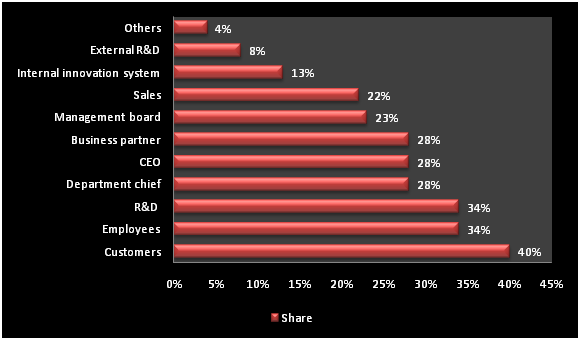
Recently I took part in a quite interesting discussion concerning innovation. The discussion focused on the generation of innovative ideas by using collaboration tools and web 2.0 / social media approaches. There were a number of interesting aspects, i.e. which stakeholder segment would generate the best ideas for an organization. The answer to this particular issue was quote simple: Your customer is your company’s biggest innovator. So, let us have a brief view on current research data:

(Note: The study allowed multiple answers; hence the sum is larger than 100 %. Source: Grant Thornton)

All data and more information can be found in the International Innovation Report 2009 by Grant Thornton.

Considering this data, I would recommend to create a new type of innovation strategy: Instead of “Research and develop you should focus on Connect and develop“.

November 14, 2010
by Oliver
Comments Off on Two ideas for improving strategic planning

Two ideas for improving strategic planning

This post has the objective to analyze and to discuss one selected problem and barrier related to the strategic planning process; those problems and barriers for a sound strategic planning process have been indentified in both the academic and the business literature.

In the last two decades a large number of articles and books related to this matter have been published. Strategic analysis, agenda setting, strategy implementation including progress monitoring are confronted with barriers very often. Typically some barriers have a strong link with specific phases and their attributes. Opposite and important as well are those barriers that can be found in the organizational context, e.g. in corporate culture.

When analyzing external and internal factors most organizations employ a static view of these factors. One solution to that matter can be to see the market place as a dynamic field with actions and reaction and therefore to consider secondary effects to one’s own strategy. Another key problem area can be found in the large number of external data.

Dynamic view of the market place. In order to develop a successful and sustainable strategy, organizations should also apply an approach that considers the impact of so called secondary effects. Furthermore planned systems and structures should also be in place for tomorrow’s environment. AVILA et al (1995) recommend taking a dynamic view of the marketplace. Therefore organizations should anticipate competitive reactions and explicitly incorporate them into their strategic analysis. This dynamic view is in line with the recommendations by FARRELL and ASSOCIATES (1995) who stress that organizations’ strategy analysis should include products, markets and channels of both today and tomorrow. Continue Reading →

November 7, 2010
by Oliver
Comments Off on A short review of 2010

A short review of 2010

Basically it is a little bit to earlier for an annual review, isn’t it? The idea to name this post review considered the fact that my last post is dated April 8th 2010. What happened? The last months have been full with changes and challenging projects in my professional life, most of them quite time consuming. In addition – well the term “in addition” is definitely an underestimation – our sweet sunshine Stella Christin became 2 years; hence now she wants to have “more” from her parents and discovers her world more and more.

To illustrate the last months I post some kind of timeline with some illustrations and pictures.

May 2010 – I

The advisory board of our corporate group decides to sell the operative business and the brand of BAG (the company I work for as commercial director and authorized officer) to an external investor, the DZB BANK. This transaction offers amazing opportunities for us to develop our business model and to establish new financial services for our customers. Since we are familiar with our future colleagues from a major IT project, we were very happy with this development. Together with a colleague from our new parent company I became managing director of the new company.


May 2010 – II

Due to projects planned in 2009 I traveled to Kazakhstan in order to run a seminar for local publishers. The 2 day seminar focuses on business fundamentals, financial controlling and positioning. “My students” are managers from publishing houses in Kirgizstan and Kazakhstan; they all are keen on learning new things. It really enjoy teaching and discussing. Our expedition to the DAUIR-publishing house was very interesting, too. It was my very first training by using consecutive interpreting. My translator was a teacher from the University of Almaty and it worked very well.

How to get to Kazakhstan? There are two basic options: (a) a non-stop flight from Frankfurt to Almaty, which is very expensive and lets you arrive at midnight. (b) a transfer flight from Frankfurt to Prague and then from Prague to Almaty with Czech Airlines. This is less expensive and lets you arrive in the morning. Option b is the better one.


Discussion during the break


Continue Reading →

April 8, 2010
by Oliver
Comments Off on Financial service brands

Financial service brands

For the purpose of my PhD-thesis in the field of banking I have to make a lot of literature review and analysis of existing studies. Thanks to universities, teachers, research and consulting companies a pure vast of excellent information is available. In the last 3 and half years I really got used to it. However, sometimes I am still surprised what kind of data – in a positive light – is available.

For all banking and marketing interested persons – for the latter one with a key focus on brand issues – this current study regarding the brand value of financial service companies might submitt very interesting data. The study “Brand Finance Banking 500” does provide an opinion as to point-in-time valuations of the biggest banking brands. The report also presents how the methodology and findings can be used to assess the impact of brand equity on business performance. It gives your relevant data on all 500 top brands; furthermore the top 5 brands have been presented for each business segment, i.e. consumer banking, corporate banking.

The study report is available as pdf-file on this website.

April 7, 2010
by Dagmar
1 Comment

The only one who really needs the ocelot, is the ocelot.

Some businesses are like ocelots

This is a quote from the famous zoologist and animal film-maker Bernhard Grzimek. I liked this quote right from the beginning because it made me smile and it seemed to have the potential for a running gag.

I want to make one thing clear right from the beginning. I am sure the ocelot is an interesting animal and it surely has more functions in our ecosystem than just making other ocelots happy.

However, this ocelot some sort of analogy for me – an analogy for things that are just there, things that always have been there and that we are so used to that we don’t even realise that we could as well live without them.  Continue Reading →

March 14, 2010
by Oliver
Comments Off on Lehman Brothers and its approach to look better

Lehman Brothers and its approach to look better

A couple of months ago I presented a fictitious interview with the former investment bank regarding its approach to manage liquidity risks. Everything seemed to be fine…but as we know from hindsight the annual report didn’t tell us the truth (otherwise the bank would not have fall into bankruptcy). Lehman Brother was collapsed under a burden of debts of 600 billion USD. Even if the previous post questions the external reporting of the investment bank, a new report informs about a shocking truth. Now a special investigator’s report confirms cheats regarding the balance. The investigator discloses a framework of lies and lets former auditing firm E&Y look bad.

Months before the actual collapse the US investment bank Lehman Brothers faced serious problems. With cheating its balance the bank covered their problems and misled investors, business partners and authorities. This is the final outcome of a 2,200 page investigation report. The table of contents alone consists of 45 pages. The report has been authorized for release by the relevant court for insolvency. The blog in the Wall Street Journal has published a copy of the Court Examiner’s Report on this website.

The court-appointed investigator Anton Valukas (from Jenner and Block) summarizes that the investment bankers made expert bookings to erase risks from their balance. As the result the bank was able to present itself as a healthy institution to external parties. With some tricks was able to create an outward impression to reduce its debts in 2008. In fact the bank had to manage a 600 billion USD debt burden.


Dilbert.com


March 3, 2010
by Dagmar
1 Comment

Dynamite Prize in Economics

Subscribers to the Real-World Economics Review Blog have awarded the Dynamite Prize in Economics to Alan Greenspan, Milton Friedman and Larry Summers.

It says at the Real-World Economics Review Blog:

‘Alan Greenspan has been judged the economist most responsible for causing the Global Financial Crisis. He and 2nd and 3rd place finishers Milton Friedman and Larry Summers, have won the first–and hopefully last—Dynamite Prize in Economics.
They have been judged to be the three economists most responsible for the Global Financial Crisis. More figuratively, they are the three economists most responsible for blowing up the global economy.’

My first thought on this post was that it was interesting reading but nothing more – there are countless polls around in the Internet and ‘economists-bashing’ at a time when we all know what had happened and why is fairly easy. However, this poll is about more. In fact, the Real-World Economics Review Blog had launched two polls simultaneously:

‘The  Real-World Economics Review Blog is holding polls to determine the awarding of two prizes:
The Dynamite Prize for Economics , to be awarded to the three economists who contributed most to enabling the Global Financial Collapse (GFC), and
The Noble Prize for Economics , to be awarded to the three economists who first and most cogently warned of the coming calamity.’  

As they write:

‘It is accepted fact that the economics profession through its teachings, pro-nouncements and policy recommendations facilitated the GFC.  We also know that danger signs became visible long before the event and that some economists (those with their eyes on the real-world) gave public warnings which if acted upon would have averted the human disaster. … To date, however, the world’s major economics associations have declined to censure the major facilitators of the GFC or even to publicly identify them. … Nor has the economics establishment offered recognition to those economists who were not taken in by fads and fashion and whose competence, if listened to, would have prevented the collapse.’

This double-poll gives me a positive outlook. They don’t simply want to blame somebody, as too many others have done. They want to direct our awareness to those who were outspo-ken with a different opinion.
I am deeply convinced that the next bubble or the next crisis will come up sooner or later. This little double poll should remind us not only to listen to the mainstream-voices that can be heard all over the mainstream media. It is convenient to agree with their convincing ideas. However, there are always some critical voices with a different opinion too. We should make it a habit to listen to those voices as well. On that basis, we can make up our own mind on whom we believe. Maybe that could help to make the next crisis a little less severe.

By the way, the poll for the Noble Prize for Economics, which was named Revere Award in Economics, named in honour of Paul Revere and his famous ride, is still open and in the nomination phase.

February 25, 2010
by Dagmar
Comments Off on A new early indicator?

A new early indicator?


I just discovered a new early indicator. You may remember that I like the sort of indicators that are not scientific but can be observed in ordinary life. Now I have one more of this sort.

We participate in the amazon-associates program with our management portal. We recommend books on the portal and when one of our visitors buys a book though our links, we get a small referral fee (unfortunately really smaller than it used to be in the early years). For these sales amazon provides us some statistics from which we know which articles were sold. It is not surprising that most of them are business books.

As of today, our sales / referral fees for this month look quite good. They look definitely better than in most of last year’s months, which were pretty weak. That may indicate two different things:

  • People think that the worst of the current financial and economic crisis is over and start again to invest in business books. Or
  • People think the crisis is not yet over. Hence, they decide to do something for their education while they are not so busy in business and hope to be well prepared when the economy booms again.

Well, this is no rocket science and no valuable indicator. More interestingly, I realised that the proportion of M&A-books among our referrals has risen considerably. I assume people expect M&A-transactions to increase again. Maybe many of our visitors work for a company that is either planning to take over another one or that is under threat of being taken over. So they want to prepare themselves with more knowledge about the process to come.
So I think that I will have a closer look at the mix of topics covered by our referrals.

February 4, 2010
by Dagmar
4 Comments

Banking Banana Skins

A banana skin may be slippery and may cause you to stumble or even fall when you Stepp on it. Hence, ‘Banking Banana Skins 2010 – After the ‘quake’  is the name of a new study from the CSFI Centre for the Study of Financial Innovation   which is sponsored by PricewaterhouseCoopers. As PwC describes it, Banking Banana Skins 2010 puts together a league table identifying potential sources of risks to banks and ranks them by severity. This year’s survey is based on over 400 responses from 49 countries.
Continue Reading →

January 30, 2010
by Oliver
Comments Off on EU-Integration level of retail banking markets

EU-Integration level of retail banking markets

OliverThe establishment of a single market for services and goods – including banking – has for several decades been one of Europe’s core policy objectives. The way towards these objectives is termed integration process. The benefit of integration is to offer new business opportunities in Europe for the banks through more competition and the option to increase returns to scale. For customers integration offers EU access to a similarly broad and fair prices range of banking products. The potential segment regarding Pan-European retail banking has been estimated with approximately 40 million customers among EU-25. Across the markets for goods and services different levels of integration has been reached. COM (2007) argues that significant progress has been made in establishing a single market for retail financial services with the introduction of legal frameworks regarding financial soundness of retail financial service providers. However, according to DIECKMANN (2006), COM (2007), BDB (2008) and SCHÄFER (2009) one of the least integrated markets in the EU is retail banking. A full integration of retail banking markets would represent “a truly single internal market for retail banking products would imply consumer demand for bank services EU-wide and provision of these services EU-wide by banks”.

DIECKMANN (2006) and SCHÄFER (2009) describe several economic benefits of retail banking integration. In general integration can increase economic welfare due to two channels. The first reason is an intensified competition on formerly national markets. In an integrated market “foreign” retail banks are able to launch banking business there at any time. In this case consumers have a broader selection of better banking products at lower prices. Secondly market integration would enable banks to realise economies of scale if they could offer their banking products across the countries of the EU. This option would lower the costs of making their banking products. Furthermore the break-even point of innovations would be reduced. Economies of scale could also be achieved in risk management, since banks could diversify their risks more in a larger market, e.g. by offering personal loans in different countries. Furthermore a better integrated banking market should improve the competitiveness of EU financial centre globally.

Continue Reading →