
Eddielogic

– Thoughts on Strategy and Management

July 25, 2013
by Oliver
Comments Off on More benefits from knowledge management

More benefits from knowledge management

Knowledge management is an important approach for organizations to manage their insights and experiences. Hence it can play a vital role in the strategic management of a firm, in particular in the area of maintaining and developing competitive advantages. In my news box I found these interesting figures and statements today.

According to a new report by University of Greenwich Professor Colin Coulson-Thomas organizations are capturing and sharing the wrong sort of knowledge. Based upon a five-year investigation, the report Transforming Knowledge Management sets out a more affordable route to high performance organizations. “Knowledge management initiatives have been excessively general and overly complex, and they have not delivered hoped for results,” claims Coulson-Thomas. He continues “A more focused and flexible approach is required that can quickly impact upon performance, achieve multiple objectives and provide clear benefits to both people and organizations.” Continue Reading →
June 11, 2013
by Oliver
Comments Off on Inflight advertising and its impact on the purchasing of the Chinese traveler

Inflight advertising and its impact on the purchasing of the Chinese traveler

The impact of marketing on potential buyers represents a frequent research objective. In my news box I found these interesting figures and statements today.

A survey was conducted in collaboration with the JMG-Research firm in Paris to measure the impact of inflight advertising (press, TV and digital) on the Chinese traveler. A sample of 4,516 travelers from Beijing and Shanghai, revealed that 39% have purchased the product after seeing it inflight, 64.8% visit a duty free store to actually see the product, 47.5% purchased the product in a different location other than the duty free zone, 54.8% searched for information after seeing the product in ads and 63.7% told relatives or friends. Continue Reading →

February 18, 2013
by Dagmar
Comments Off on The Terminology of Strategy – When Leaders Mistake Execution for Strategy

The Terminology of Strategy – When Leaders Mistake Execution for Strategy

There is an interesting article about the terminology of strategy at strategy + business: How Leaders Mistake Execution for Strategy (and Why That Damages Both) by Ken Favaro. Its subtitle is When leaders substitute visions, missions, purposes, plans, or goals for the real work of strategy, they send their firms adrift. This article is exactly in line with my personal experience.

When I worked with managers from middle management up to senior executives in the process of strategy development, I often found that they have problems with the terminology of strategy. There seems to be a lack of clarity about the real meaning of terms like strategy, vision, mission, plan, strengths, opportunities and so on.  Hence, a concept is used without proper understanding. A strategy that is developed on that basis is not a strategy but a compilation of thoughts and ideas labeled with some strategic terms. Not surprisingly, such a “strategy” will hardly deliver the expected results. Continue Reading →

February 6, 2013
by Dagmar
Comments Off on Thinkers50 Awards for 2013 now open for nominations

Thinkers50 Awards for 2013 now open for nominations

The Thinkers50 Awards are a global ranking of top management thinkers. First launched in 2001, it has been published every two years since. It’s purpose is to identify and share the best management thinkers in the world. In 2011 the Thinkers50 Category Awards were established and – as it is written on the website ‘immediately hailed as the “Oscars of management thinking”‘. Previous award winners were Clayton Christensen (2011), CK Prahalad (2009 & 2007), Michael Porter (2005) and Peter Drucker (2003 & 2001).

There are 7 categories of the Thinkers50 awards now. The categories and the 2011 winners are: Continue Reading →

February 4, 2013
by Dagmar
1 Comment

When to develop strategic measures

I struggled a bit with the heading of this article. More precisely it should read “With which frequency and on which occasions to develop strategic measures”. It is the old dilemma that, ideally, strategic planning should be a continuous process that is incorporated in the ongoing activities. However, all too often managers are too busy with their day-to-day duties and ad-hoc demands of their business. Luckily, there is the annual strategic planning cycle. So it can be tempting to postpone any thoughts about strategy until that occasion.

So here is my vision how it should be done, how it should not be done, and what could be done between these two extremes: Continue Reading →

January 30, 2013
by Dagmar
Comments Off on It is so easy to make employees happy

It is so easy to make employees happy

I experienced something extraordinary at work today: The entire staff of the company was united in total happiness. You could see people smiling and sharing their emotions everywhere on the floors. What had happened?

A very simple thing: All coffee machines were replaced by new ones from a different brand and supplier. The lease agreement for the old coffee machines had expired and management had taken the one right decision – they changed the supplier. Continue Reading →

January 7, 2013
by Oliver
Comments Off on Does your company know its core competencies?

Does your company know its core competencies?

It is unquestioned, that core competencies are essential for the success of a company. Hamel and Prahalad, two top strategic management thinkers employed the term core competencies in order to highlight the combined “set of skills, activities and resources that, together, deliver customer value, differentiate a business from its competitors and, potentially, can be extended and developed.”* Bain & Company argues: “It embodies an organization’s collective learning, particularly of how to coordinate diverse production skills and integrate multiple technologies. Such a Core Competency creates sustainable competitive advantage for a company and helps it branch into a wide variety of related markets.”

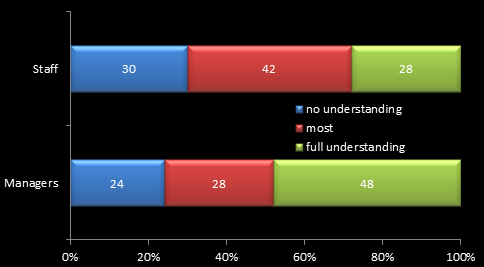
Despite the relevance of this bundle of constituent skills and technologies I would like to recommend your company to test, whether each and every employee and manager knows them and is able to transfer and to communicate them to your customers. I know that this might sound a little bit strange, but let us have a look at corporate practice. A research and consulting company observed the following results among Austrian retail banks. The key issue was to which extent managers and employees know the core competencies of their organization. The results are definitely surprising.

82.5 percent of managers and employees confirmed the existence of core competencies, but…

Figure: Share of respondents regarding their knowledge of core competencies

Data Source: emotion banking newsletter, May 2012 / VICTOR Global 2011

Continue Reading →

January 3, 2013
by Oliver
Comments Off on Top 4 bank customers‘ expectations

Top 4 bank customers‘ expectations

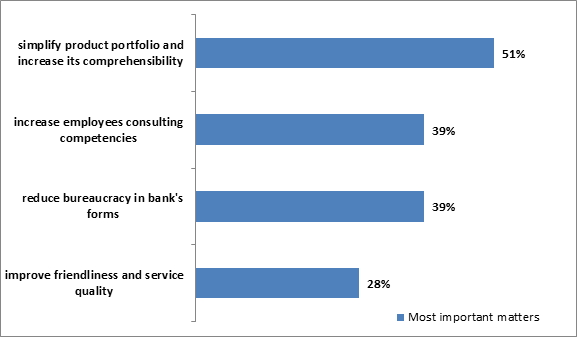
The financial turmoil has changed customers’ perceptions and expectations regarding banking significantly. Hence it is recommended that (retail) banks undertake different measures to rebuild and to maintain customer trust in the banking business. One approach for so doing is to take the perspective of the customers and to understand their demands and expectations. A recent study by Eurogroup Consulting (ECG) observed clear expectations regarding “hot topics” from the view of the customer in Germany. Retail banking customers were asked to name those matters that they would take care with a top priority, if they (the customers) would run the bank.

These are the results for the question: What would you do asap, if you were the banking management?

Data source: Handelsblatt 2012, January 2; ECG.

December 28, 2012
by Oliver
Comments Off on The characteristics of strategic decisions

The characteristics of strategic decisions

In corporate practice it is possible to observe discussions concerning the nature of strategic decisions and strategic activities. In some case terms like “strategic” or “strategy” will be employed to emphasize the long term benefits (in detail) and / or to convince others to transfer budgets and resources to specific measures and activities. However I have also observed situations were these terms have been used simply to outline potential, but unclear benefits. Basically I recommend being very analytical when someone starts to employ such term in his or her justification. Continue Reading →

December 19, 2012
by Dagmar
1 Comment

What to learn from Poor Teams

Recently, I wrote an article about High-Spirit Teams for our Management Portal: How to build True Team Spirit. This article briefly discusses the benefits of team spirit and describes processes and success factors for building team spirit. In this post, I want to focus on the opposite site – on non-performing teams.

As desirable as it is to form a spirited, high-performing team – all those teambuilding efforts will not always yield success. We all know about teams that do not match the description of a committed, motivated group of people that continuously exceeds expectations with impressive results. Not every team will be a top-performer. Here is what we can learn from them. Continue Reading →